“Why is LabVIEW better than C?” As a LabVIEW Product Manager, I get asked this question a lot.
Honestly, it is the wrong question to ask. It becomes a valid question with a little nuance and application context (for example, “Which is better for this task, under these constraints?”). Without this detail, it’s like asking why bread is better than flour.
If you want to build a measurement or control system, then NI LabVIEW system design software is a tool that can save you the risk, expense, and inconvenience of building your own from low-level languages like C. I’m not suggesting that LabVIEW is a “better” programming language than C—especially considering that large portions of LabVIEW are written not only in G but also in C and C++. Rather, they have different strengths that programmers should understand to succeed.

How is LabVIEW like bread? Read on.
The relationship between LabVIEW and C is similar to bread and flour. If you want to make a sandwich, start with bread. If you want to bake a cake, start with flour. Baking bread with flour from scratch can be expensive and time consuming (especially if you just want a quick snack), but when it comes to a cake, flour is essential. Similarly, you might find it challenging to decide which programming language is best for your task. It comes down to using the right tool for the right job.
C Gives You Low-Level Control
C is often better for applications with tight resources that must be closely managed. Since C is a relatively low-level language, it forces you to consider and specify even the smallest details, such as memory assignments and threads. A good programmer can use this low-level of control to eliminate the overhead in most higher level implementations. At this level, you can also take advantage of target architecture or host operating system properties to achieve greater performance.
NI programmers wrote most of the LabVIEW libraries in C or C++ for this reason. Operations like file I/O and analysis are as fast in LabVIEW as they are in C because they are written in low-level languages and optimized for each of the platforms and operating systems that LabVIEW supports.
Efficiency Versus Control
At some point, developer efficiency trumps the need for hand-optimized code. Relinquishing a little control to stand on the shoulders of those who have solved similar problems can benefit many projects in terms of quality productivity. Programming languages are constantly progressing toward higher levels of abstraction. This helps you focus on the problem at hand instead of the minutia of the computing.
LabVIEW: For Parallel Execution and Real-World I/O
No matter what the implementation language, high-level system design and low-level implementation must inevitably split.
In measurement and control applications, programming is just one task of a system designer. Engineers often don’t have time to keep up with or rewrite old software to support the advancements in computing and measurement hardware, operating systems, and so on. They add value by figuring out how to acquire, manipulate, and present real-world data—not by coming up with new ways to handle memory allocations and thread pools. By using LabVIEW, you can build on top of tested, supported, and maintained libraries of lower level code from NI. Choosing C means you’ll need to implement, support, and maintain your own lower level libraries or purchase them from a vendor (NI offers NI LabWindows ™/CVI software and NI Measurement Studio for this use case).
Syntax-wise, C is optimized for sequential execution of instructions as fast as the CPU can handle them. This is perfect for pure computation, when only one task is being executed and instructions are more basic. The graphical syntax in LabVIEW, on the other hand, is optimized for the parallel execution of tasks that have real-world timing constraints.
LabVIEW allows you to skip building a foundation and go straight to customization.
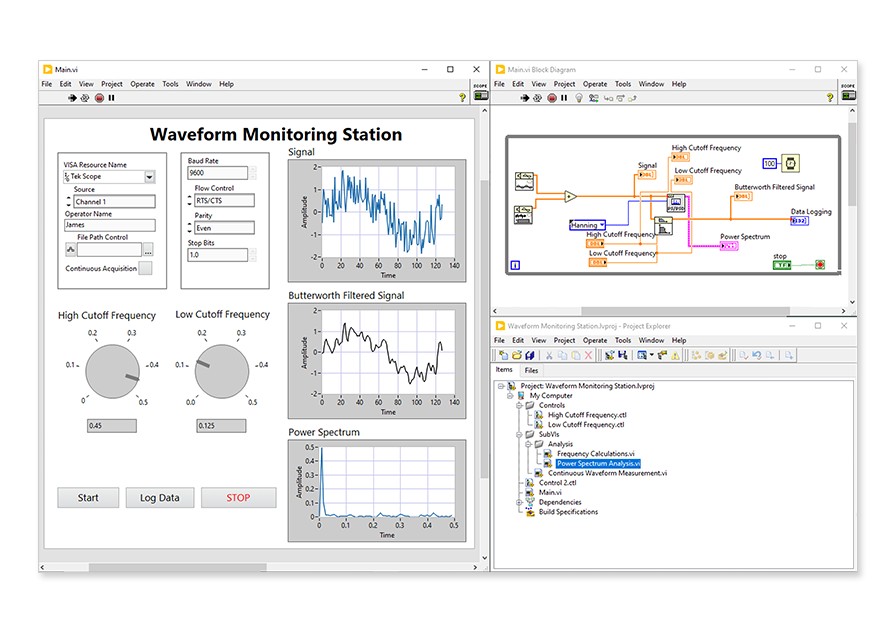
LabVIEW is more than just a programming language and associated libraries. When you use the LabVIEW integrated development environment (IDE) with NI hardware, you get a development experience that is greater than the sum of its parts. The software is aware of available hardware resources and can present available I/O channels and execution targets as drop-down menus and project items. You can prevent or catch incorrect configurations during editing, to avoid costly, hard-to-debug runtime errors. Next-generation measurement hardware (such as the NI PXIe-5644R vector signal transceiver) even allows LabVIEW to redefine the firmware of the hardware to reach performance levels that traditional, distinct programming languages and instruments can’t.
Too many projects end up late or over budget because people underestimate the efforts required to stitch together parts from disparate sources. When you use LabVIEW, your hardware drivers return data in the same format as the analysis libraries consume, your UI widgets display technical data in the same format that the analysis libraries produce, eliminating the need to piece together components.
So Which is Better: LabVIEW, or C?
The answer might as well be “42.” To draw from The Hitchhiker’s Guide to the Galaxy, the answer isn't meaningful until you know which question you are asking or what problem you are trying to solve. LabVIEW and C are both useful tools that, in the hands of skilled users, can solve almost any problem: LabVIEW tends to be better for high-level test, measurement, and control applications, and C is more apt for lower level implementations of computationally intensive tasks.
The next time someone asks you whether LabVIEW trumps C, feel free to answer “42”. It may be the only response that will get the discussion heading in the right direction.
To learn more about LabVIEW and the NI integrated development environment, visit ni.com/labview.
- NI LabVIEW Product Marketing Manager Simon Hogg
Reader Comments | Submit a comment »
The way I see it
If want a EE to play the role of a Test
Engineer, then LabView is probably the
best approach. However, if you have a
Test Engineer in the role of a Test
Engineer then LabWidnows/CVI is the
best choice. The Test Engineer-pure
can exploit an ROI from the
Development Team which is VERY likely
to have developed Firmware and initial
functional/integration testing using a C-
based (or a language with similar syntax
as C) IDE. I would NOT use a C IDE
other than LabWindows/CVI in either
case. NI does an excellent job with
extending ANSI C capabilties via
LabWindows/CVI (just check-out the
great plug-ins/functions especially the
Analysis ones)!
- Anthony Conway, Test Engineer. - Mar 28, 2013
Typing vs Programming
I've been using LV since v2.5, around
1992. I recently started brushing up on C,
since it's still heavily used by colleagues,
especially in embedded programming.
Just like in the 1990's, I've spent about
half my time looking for typographical
errors in the exercises I've done. Typos.
Not learning about information flow or
programming techniques. The
compilers, to this day, appear to only give
cryptic hints as to what one may have
done wrong.
I suppose I'll get better at this but it
seems to be an awful waste of time.
Regarding printing, seriously, how many
of us actually USED a program printout in
th last 20 years? It's a bit like printing
emails, no?
- William Gilbert, University of Minnesota . wgilbert@physics.umn.edu - Feb 18, 2013
LabVIEW does have a place
I developed DoD applications for over 30 years
and I was glad to see LabVIEW come along.
My development projects had been directed to
use a different language on about every one.
We had developed on Fortran, Cobalt, ADA,
BASIC, C, C++, and different assembly
compilers. It seemed like DOD was searching
for the perfect solution, but instead it just
introduced reinvention of the same functionality.
I tried an evaluation version of Labview back in
1994, and then took some training in 1995. It
had so many libraries and equipment drivers, so
we knocked out a 1996 project within months
instead of years. I love the way it can use
shared libraries, so you could use your old code
if you found a need but we always had to rebuild
the code even if we didn't touch it. Our
customer was always wanted the latest
Windows computers, so keeping up with the
hardware was easier and performance always
seemed to improve. I continue to use and
endorse it. DOD stubbornly clings to C/C++
even if you show them the power of LabVIEW,
but I suspect its more a culture and business
reasons. All the programmers learn C/C++, so
fear of learning something new or loss of control
creeps in. On the business side of DOD,
software development is billed by the hour so if
you are too efficient that cuts into your profits.
I'm retired and freelance now, so I target
customers that just want the job to get done in
the most efficient way; time, cost, robust, and
quickly updated. GO LABVIEW!!
- David Neumann, Freelance Research Protos LLC. freelance_research_protos@aol.com - Feb 14, 2013
LabVIEW makes easier overview
Well, I am LabVIEW'ing since v3.0. And
honestly, I love it. But in the last few
years I also had to do some work with textual
languages. And I hate it!
It is so much harder to keep the overview
over bigger systems. One has much more
trouble with multi-tasking/-threading. One
has to remember much more with textual coding.
LV has its own pitfalls and limits, but
overall I'm much more productive with LV than
with textual languages. And that's what
counts for me.
- Uwe Frenz, getemed AG. u.frenz@getemed.de - Jan 14, 2013
... I need a bigger plotter to print my program.
&%@( Jim, I'm a programmer, not a graphic
artist!
- Jan 9, 2013
Well put, however...
it makes me concerned that there is the need
to explain the C vs. LabVIEW paradigms to a
community of "Software Developers". Welcome
to a world full of BLOATWARE! Aaahhh...
- Jan 8, 2013
...but you need to first ask how many years your application will operate without additional funding.
The first question you really need to ask
(before you ask the LabVIEW or C
question), assuming you are not just a
developer, but also a software manager,
is whether or not your application must
be supported for many years (perhaps
decades, as in many U.S. DoD
programs) without repeated funding
input, from either your customer or from
your internal organization. Histroically,
LabVIEW source requires somewhat
annual updates to the project code base
in order to stay current with the IDE. This
is because LabVIEW has greatly evolved
over the past 20+ years, for the benefit of
all. This is not to say that this does not
also happen with C (and CVI), but
updates to the C source code base are
typically because of funded updates and
bug fixes, not because your IDE has
simply evolved forward in time. The
good news is that NI has partially
addressed this by now supporting the
ability in LabVIEW to open-forward and
save-backwards to/from certain older
versions of LavVIEW source. But again,
the developer(s) must excercise caution
when excercising this feature, and
rigorous re-testing of the deployed
application is also recommneded of
course.
- David A. Belliveau, BAE Systems, Inc.. david.belliveau@baesystems.com - Jan 8, 2013
Exactly!
As someone who programmed exclusively
in LabWindows/CVI through the 1990s and
has been developing in LabVIEW since
2000, your analogy is perfect.
"42" will be my answer from now on.
- William L Weaver, La Salle University. williamlweaver@gmail.com - Jan 8, 2013
Rephrased Version
While 'C'ing is believing (Lab)VIEWing is
understanding ... Which would you
choose?
- giriseshadri@yahoo.co.in - Jan 8, 2013
Legal
This material is protected under the copyright laws of the U.S. and other countries and any uses not in conformity with the copyright laws are prohibited, including but not limited to reproduction, DOWNLOADING, duplication, adaptation and transmission or broadcast by any media, devices or processes.