


Table of Contents
Overview
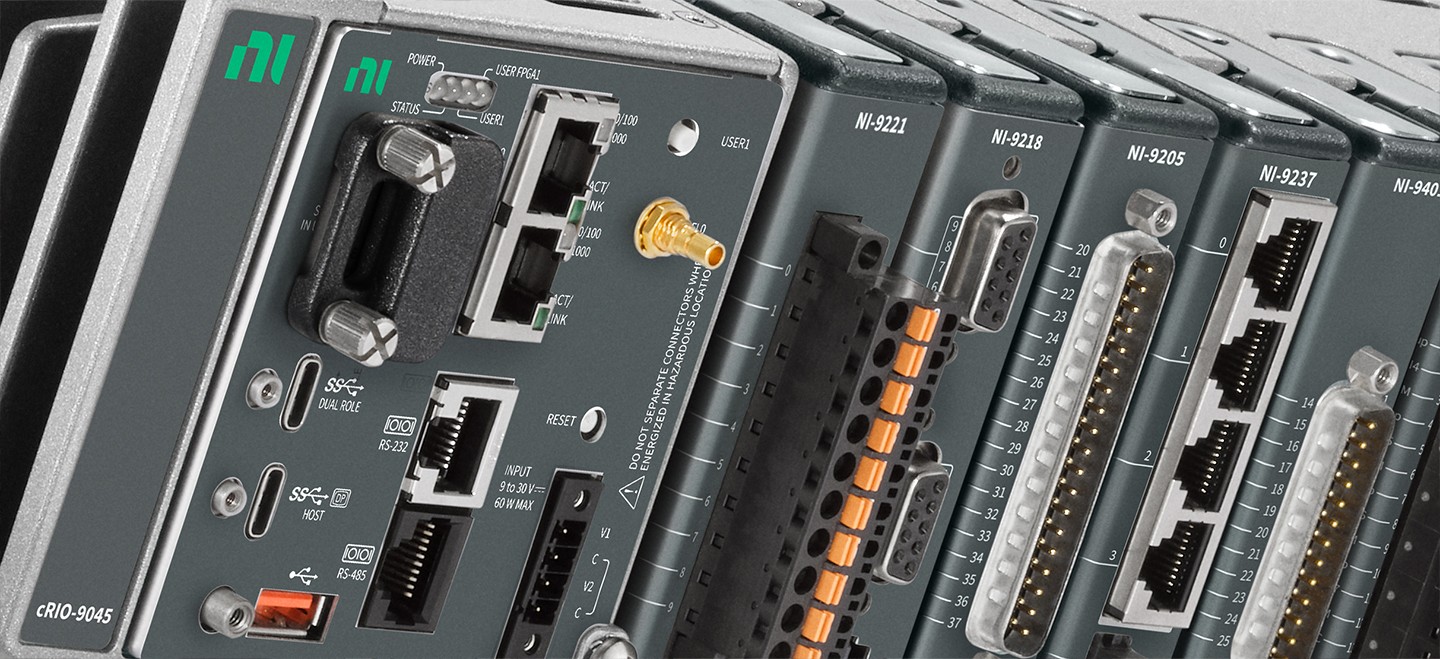
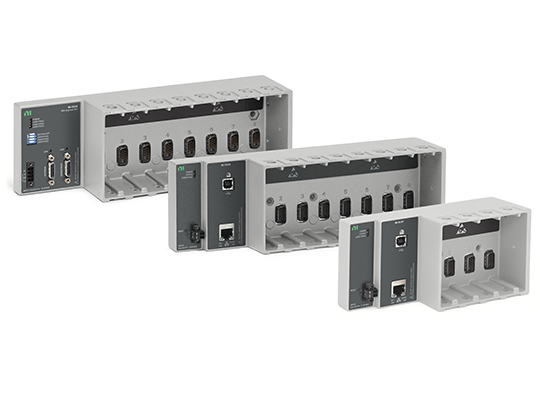
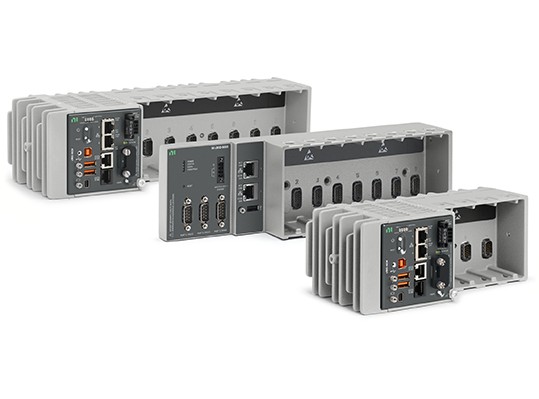
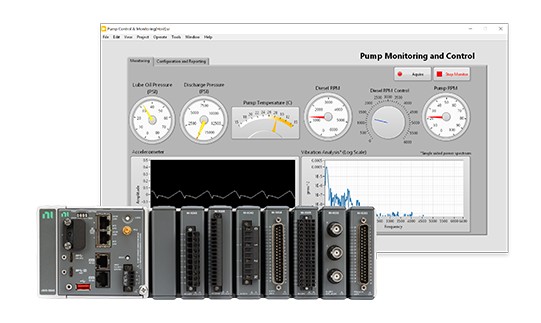
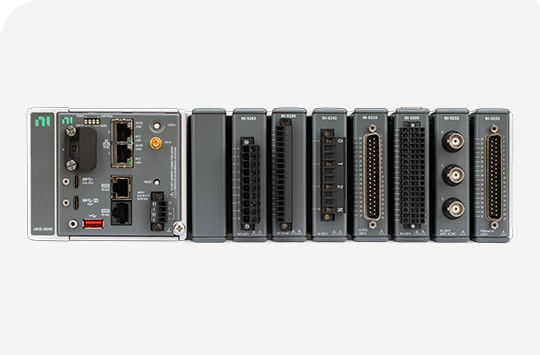
National Instruments CompactRIO is a small rugged industrial control and acquisition system powered by reconfigurable I/O (RIO) FPGA technology for ultrahigh performance and customization. NI CompactRIO incorporates a real-time processor and reconfigurable FPGA for reliable stand-alone embedded or distributed applications, and hot-swappable industrial I/O modules with built-in signal conditioning for direct connection to sensors and actuators. CompactRIO represents a low-cost architecture with open access to low-level hardware resources. CompactRIO embedded systems are developed using high-productivity LabVIEW graphical programming tools for rapid development. With NI CompactRIO, you can rapidly build embedded control or acquisition systems that rival the performance and optimization of custom-designed hardware circuitry. The CompactRIO platform includes cRIO-900x cRIO-901x real-time controllers with industrial floating-point processors, the cRIO-910x family of 4 and 8-slot reconfigurable chassis featuring 1 million or 3 million gate FPGAs. The platform also includes the new cRIO-907x family which comes as an integrated controller and chassis. CompactRIO C series modules provide a wide variety of I/O types, from ±80 mV thermocouple inputs to 250 VAC/VDC universal digital inputs. CompactRIO embedded systems are developed using LabVIEW, the LabVIEW Real-Time Module and the LabVIEW FPGA Module. There are three configurations for CompactRIO - embedded systems (including the CompactRIO integrated controller and chassis), R Series expansion systems, and the remote high-speed interfacte system.
CompactRIO Embedded System
A CompactRIO embedded system features a real-time embedded processor, 4 or 8-slot reconfigurable chassis containing a user-programmable FPGA, and hot-swappable industrial I/O modules. This low-cost embedded architecture delivers open access to low-level hardware resources for rapid development of custom stand-alone or distributed control and acquisition systems.
CompactRIO R Series Expansion System
The CompactRIO R Series expansion system uses the same hot swappable industrial I/O modules to provide high-performance signal conditioning and industrial expansion I/O for PCI or PXI/CompactPCI R Series FPGA devices. The expansion system adds custom measurement capabilities to applications that include traditional plug-in data acquisition, vision, motion, and modular instrument devices.

CompactRIO Remote High-Speed Interface System
The CompactRIO Remote High-Speed Interface System uses the same hot swappable I/O modules as the rest of the CompactRIO platform to provide High-Speed interfacing with a Windows Desktop or Notebook. The 90xx Real-Time controller from the embedded system is replaced by a high-speed remote controller that enables data transfer rates of up to 50MB/s.

Low-Cost Open Architecture
CompactRIO combines a low-power-consumption real-time embedded processor with a high-performance RIO FPGA chipset. The RIO core has built-in data transfer mechanisms to pass data to the embedded processor for real-time analysis, postprocessing, data logging, or communication to a networked host computer. CompactRIO provides direct hardware access to the input/output circuitry of each I/O module using LabVIEW FPGA elemental I/O functions. Each I/O module includes built-in connectivity, signal conditioning, conversion circuitry (such as ADC or DAC), and an optional isolation barrier. This design represents a low-cost architecture with open access to low-level hardware resources.

I/O Modules
Each CompactRIO I/O module contains built-in signal conditioning and screw terminal, BNC, or D-Sub connectors. By integrating the connector junction box into the modules, the CompactRIO system significantly reduces the space requirements and cost of field wiring. A variety of I/O types are available including ±80 mV thermocouple inputs, ±10 V simultaneous sampling analog inputs/outputs, 24 V industrial digital I/O with up to 1 A current drive, differential/TTL digital inputs with 5 V regulated supply output for encoders, and 250 Vrms universal digital inputs. Because the modules contain built-in signal conditioning for extended voltage ranges or industrial signal types, you can usually make your wiring connections directly from the CompactRIO module to your sensors/actuators. In addition, you can create your own modules using the CompactRIO I/O Module Development Kit. Visit ni.com/compactrio for the latest information on module availability.

Real-Time Processor
The CompactRIO embedded system features an industrial class processor that reliably and deterministically executes your LabVIEW Real-Time applications. Choose from thousands of built-in LabVIEW functions to build your multithreaded embedded system for real-time control, analysis, data logging, and communication. The controller also features a 10/100 Mb/s Ethernet port for programmatic communication over the network (including e-mail) and built in Web (HTTP) and file (FTP) servers. Using the remote panel Web server, you can automatically publish the front-panel graphical user interface of your embedded application for multiclient remote monitoring or control. The real-time processor also features dual 11 to 30 VDC supply inputs, a user DIP switch, LED status indicators, a real-time clock, watchdog timers, and other high-reliability features.

Reconfigurable Chassis
The reconfigurable chassis is the heart of NI CompactRIO embedded systems, containing the RIO FPGA core. This user-defined RIO FPGA is a custom hardware implementation of your control logic, input/output, timing, triggering, and synchronization design. The RIO FPGA chip is connected to the I/O modules in a star topology, for direct access to each module for precise control and unlimited flexibility in timing, triggering, and synchronization. A local PCI bus connection provides a high-performance interface between the RIO FPGA and the real-time processor. The reconfigurable chassis features the same rugged metal construction that characterizes the entire CompactRIO platform.

Integrated Controller and Chassis
The integrated configuration combines the embedded real-time controller and chassis containing the FPGA in a single unit. This configuration provides all of the functionality of the modular controller and chassis, and has been optimized for cost which makes this system ideal for high volume applications.

Reconfigurable I/O (RIO) Technology
With NI RIO technology, you define your own custom measurement hardware circuitry using reconfigurable FPGA chips and LabVIEW graphical development tools. Now you can take advantage of reconfigurable FPGA technology to automatically synthesize a highly optimized electrical circuit implementation of your input/output, communication, or control application.

[+] Enlarge Image
Field-Programmable Gate Arrays (FPGAs)
FPGA devices are widely used by control and acquisition system vendors because of their performance, reconfigurability, small size, and low engineering development costs. FPGA based devices have been traditionally vendor defined rather than user defined because of the complexity of the electronic design tools. Now you can take advantage of user-programmable FPGAs to create highly optimized reconfigurable control and acquisition systems with no knowledge of specialized hardware design languages such as VHDL. With CompactRIO, you can design your own custom control or acquisition circuitry in silicon with 25 ns timing/triggering resolution.

[+] Enlarge Image
FPGA devices feature a reconfigurable digital architecture with a matrix of configurable-logic blocks (CLBs) surrounded by a periphery of I/O blocks. Signals can be routed within the FPGA matrix in any arbitrary manner by programmable interconnect switches and wire routes. CompactRIO offers 4 and 8-slot chassis with options for either 1 million or 3 million gate FPGA chips.
Performance, Size, and Weight
Using LabVIEW FPGA software and reconfigurable hardware technology, you can create ultrahigh performance control and acquisition systems with CompactRIO. The FPGA circuitry is a parallel processing reconfigurable computing engine that executes your LabVIEW application in silicon circuitry on a chip. You can design your own custom control or acquisition circuitry in silicon with 25 ns timing/triggering resolution. LabVIEW FPGA features built-in functions for analog closed-loop PID control, fifth-order FIR filters, 1D look-up tables, linear interpolation, zero-crossing detection, and direct digital synthesis of sine waves.

[+] Enlarge Image
With the embedded RIO FPGA hardware, you can implement multiloop analog PID control systems at loop rates exceeding 100 kS/s. Digital control systems can be implemented at loop rates up to 1 MS/s, and it is possible to evaluate multiple rungs of Boolean logic using single-cycle while loops at 40 MHz (25 ns). Due to the parallel nature of the RIO core, adding additional computation does not necessarily reduce the speed of the FPGA application.

Size and Weight
CompactRIO is designed for applications in harsh environments and small places. Size, weight, and I/O channel density are critical design requirements in many such embedded applications. By taking advantage of the extreme performance and small size of FPGA devices, CompactRIO is able to deliver unprecedented control and acquisition capabilities in a compact, rugged package. A 4-slot reconfigurable embedded system measures 179.6 by 88.1 by 88.1 mm (7.07 by 3.47 by 3.47 in.) and weighs just 1.58 kg (3.47 lb). An 8-slot system filled with 32-channel I/O modules delivers a mass channel density of 9.7 g/ch (0.34 oz/ch), and a volumetric channel density of 8.2 cm3/ch (0.50 in.3/ch).
| Dimensions (4-slot) | 179.6 by 88.1 by 88.1 mm (7.07 by 3.47 by 3.47 in.) |
| Dimensions (8-slot) | 274 by 88.1 by 88.1 mm (10.79 by 3.47 by 3.47 in.) |
| Weight (4-slot, typical) | 1.58 kg (3.47 lb) |
| Weight (4-slot, typical) | 2.48 kg (5.46 lb) |
| Mass-Ch density (8-ch module) | 38.7 g/ch (1.37 oz/ch) |
| Volume-Ch density (8-ch module) | 32.9 cm3/ch (2.01 in.3/ch) |
| Mass-Ch density (32-ch module) | 9.7 g/ch (0.34 oz/ch) |
| Volume-Ch density (32-ch module) | 8.2 cm3/ch (0.50 in.3/ch) |
Extreme Industrial Certifications and Ratings
CompactRIO is a reconfigurable embedded system that combines reliable stand-alone embedded capability with extreme industrial certifications and ratings for operation in harsh industrial environments. The modular CompactRIO system is rated for a -40 to 70 °C (-40 to 158 °F) temperature range, 50 g shock, and hazardous locations or potentially explosive environments (Class I, Div 2). Most I/O modules feature up to 2,300 Vrms isolation (withstand), and 250 Vrms isolation (continuous). Each component comes with a variety of international safety, electromagnetic compatibility (EMC), and environmental certifications and ratings. To find the industrial certifications and other specifications for each device, refer to the operating instructions manual. Visit http://sine.ni.com/manuals/main/p/sn/n23:1.4796 for more information.
- -40° to 70 °C (-40° to 158° F) operating temperature - (Modular System)
- -20° to 50° C ( -4° to 122° F) operating temperatue - (Integrated System)
- Up to 2,300 Vrms isolation (withstand)
- 50 g shock rating
- International safety, EMC, and environmental certifications
- Class I, Division 2 rating for hazardous locations
- Dual 11 to 30 VDC supply inputs, low power consumption (7 to 10 W typical) - Modular System
- Single 19 to 30 VDC input input - Integrated System
CompactRIO R Series Expansion System
In this configuration, a CompactRIO expansion chassis connects to the digital port on a PCI or PXI R Series FPGA device. The R Series device can be installed in any desktop or PXI computer system running Windows or one of the LabVIEW Real-Time OSs. The RIO FPGA resides on the R Series device while CompactRIO converts a single digital port on the R Series device into a high performance expansion I/O and signal conditioning system. The Windows host CPU or PXI RT controller provides high-performance processing for analog control, analysis, or hardware-in-the-loop (HIL) simulations. The R Series RIO device and CompactRIO chassis provide high-speed signal conditioned input, output, communication, and control capabilities and offer unprecedented flexibility and optimization.

R Series Expansion Chassis
The cRIO-9151 4-slot R Series expansion chassis connects directly to a PXI or PCI R Series device such as the PXI-7831R, PXI-7811R, or PCI-7831R. In this configuration, the FPGA resides on the R Series device and the CompactRIO I/O modules provides industrial I/O, isolation, and signal conditioning. With the PXI-7831R or PCI-7831R, you can connect up to two R Series Expansion Chassis for a maximum of eight I/O modules per R Series device. With the PXI-7811R, you can connect up to four R Series expansion chassis for a maximum of 16 I/O modules per R Series device.

OS Options for the CompactRIO R Series Expansion System
A CompactRIO R Series expansion system can be used with a desktop or PXI computer system running Windows or one of the LabVIEW Real-Time OSs. The National Instruments LabVIEW Real-Time Module (version 7.1 and higher) accepts standard desktop PCs as LabVIEW Real-Time targets. Visit ni.com/realtime for more information on selecting your real-time deployment platform.
CompactRIO Remote High-Speed Interface System
In this configuration, the National Instruments cRIO-9052 high-speed remote controller replaces a cRIO-900x real-time controller to provide a high-speed interface from any NI cRIO-910x reconfigurable chassis to a laptop, PXI system or PC. With the NI cRIO-9052, engineers can interface from the FPGA inside of a CompactRIO chassis at rates up to 50 MB/s. The result is a remote, reconfigurable solution ideal for applications requiring the flexibility of the FPGA within CompactRIO along with a high-speed interface to a laptop or PC. You can choose to interface the CompactRIO high-speed remote system to a LabVIEW Windows application running on a laptop, PC or PXI system or to a LabVIEW Real-Time application running on a PC or PXI system.
LabVIEW Real-Time (ETS)
LabVIEW Real-Time for ETS provides the greatest selection of PXI chassis, controllers, and plug-in modules for data acquisition, vision, motion, modular instruments, and industrial networking (CAN, GPIB, serial, etc.).
| Controller | Processor | RAM (maximum) |
| PXI-8145 RT | 266 MHz Pentium MMX | 128 MB, DRAM |
| PXI-8175 RT | 866 MHz Pentium III | 512 MB, SDRAM |
| PXI-8176 RT | 1.2 GHz Pentium III | 512 MB, SDRAM |
| PXI-8186 RT | 2.2 GHz Pentium 4-M | 1 GB, DDR SDRAM |
| PXI-8187 RT | 2.5 GHz Pentium 4-M | 1 GB, DDR SDRAM |
Real-Time Control Application Design
Reconfigurable control and acquisition systems typically contain four major components:
- RIO FPGA core application for input, output, communication, and control
- Time-critical loop for floating-point control, signal processing, analysis, and point-by-point decision making
- Normal-priority loop for embedded data logging, remote panel Web interface, and Ethernet/serial communication
- Networked host PC for remote graphical user interface, historical data logging, and postprocessing
Depending on your application requirements, you may decide to implement one or all of these application components.

LabVIEW FPGA Module
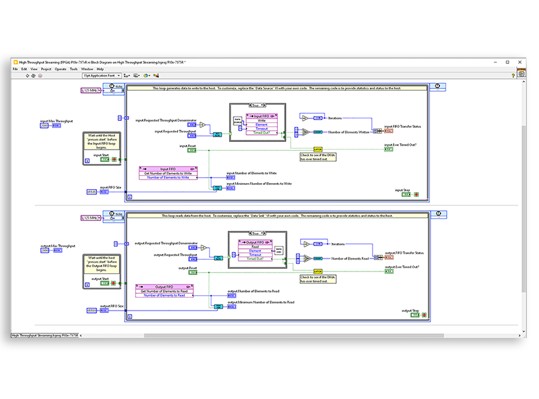
LabVIEW and the LabVIEW FPGA Module deliver graphical development for FPGA chips on NI RIO hardware. With the LabVIEW FPGA Module, you develop FPGA applications on a host computer running Windows, and then LabVIEW compiles and implements the code in hardware. Using the LabVIEW FPGA Module, you can define custom I/O and control hardware circuitry without prior knowledge of hardware design or VHDL. Graphical programming of FPGAs empowers LabVIEW users to synthesize their own custom measurement circuitry that rivals the performance and optimization of vendor-defined hardware.

[+] Enlarge Image
Key Embedded System Developer Tools
The LabVIEW FPGA Module, LabVIEW Real-Time Module, and LabVIEW for Windows development environments provide an array of tools and technologies to speed the development of advanced, reliable, and highly optimized reconfigurable embedded systems.
Embedded Project Manager
- FPGA hardware target configuration and automatic module discovery
- CompactRIO module and I/O channel alias name management
- FPGA application flash memory download and autoload configuration
LabVIEW FPGA Development Environment
- FPGA device I/O for analog input/output, digital input/output, and I/O property nodes/methods
- Interrupt (IRQ) generation and synchronization functions
- 40 MHz single-cycle timed loop for code execution in 25 ns timing interval
- Parallel processing with while loop, sequence, case, for loop, and other execution control structures
- FPGA FIFO data buffering and memory read/write
- Loop timer/counter with 40 MHz FPGA time base (25 ns tick, µs, or ms resolution)
- Boolean logic, comparison, numeric math, saturation arithmetic functions, and bitwise data manipulation functions
- HDL interface node for integration of non-LabVIEW IP cores
- Nonlinear system and discrete linear control functions including PID and fifth-order FIR filter
- 1D look-up table, linear interpolation, zero-crossing detection, and direct digital synthesis sine generator
LabVIEW Real-Time Development Environment
- Target configuration options including startup application execution settings and development, Web, remote panel, and file server access
- Open FPGA VI reference function for programmatic bit stream download, communication interface reference, and application start
- Deterministic real-time while loop thread synchronization with FPGA-generated interrupt (IRQ)
- FPGA front panel control/indicator read/write for data transfer
- Data scaling/mapping functions for integer to floating-point engineering units conversion
- Real-Time FIFO data buffering
- Timed loop structure for multirate deterministic control
- Floating-point PID, set point profiling, gain scheduling, and rate limiter functions
- Fuzzy logic control, continuous and discrete linear systems, and nonlinear systems, and 2D look-up table functions
- Point-by-point signal generation, time-domain analysis, frequency-domain transforms and spectrum analysis, filters, statistics, curve fitting/interpolation, linear algebra, array/vector operations
- SMTP E-mail, TCP/IP, UDP, IrDA, DataSocket, and VISA RS232 serial programmatic server/client communication (including 802.11 wireless Ethernet)
- Binary and text file I/O for embedded data logging and retrieval
Application Modules and Toolkits
- LabVIEW PDA Module
- LabVIEW Enterprise Connectivity Toolset
- LabVIEW Remote Panel License (5 users)
- LabVIEW Execution Trace Toolkit
- LabVIEW Order Analysis Toolkit
- LabVIEW Sound and Vibration Toolkit
- LabVIEW Signal Processing Toolset
- LabVIEW Simulation Module
- LabVIEW Control Design Toolkit
- LabVIEW System Identification Toolkit
- LabVIEW Simulation Interface Toolkit
- LabVIEW State Diagram Toolkit
LabVIEW Networked Host Application Development
- Web browser remote panel graphical user interface plug-in for remote control/monitoring (Windows, Linux, Mac OS X, Solaris)
- Express spectral signal analysis, distortion/tone, amplitude/level, timing/transition, convolution/correlation, mask/limit, histogram functions
- Local or remote database connectivity, text/HTML/DIAdem report generation
- Handheld mobile/portable PDA user interface/remote control (LabVIEW PDA Module)
Applications and Customer Successes
Because of its low cost, reliability, and suitability for high-volume embedded measurement and control applications, CompactRIO can be adapted to solve the needs of a wide variety of industries and applications. Examples include heavy industrial machine control, in-vehicle data acquisition, machine condition monitoring, and rapid control prototyping (RCP):
- Batch control
- Discrete control
- Motion control
- In-vehicle data acquisition
- Machine condition monitoring
- Rapid control prototyping (RCP)
- Industrial control and acquisition
- Distributed data acquisition and control
- Mobile/portable noise, vibration, and harshness (NVH) analysis

CompactRIO is designed for advanced developers who will use LabVIEW graphical development tools to adapt the reconfigurable hardware for a wide variety of industries and applications. Customers such as MTS, Roush, Göpel, Process Automation and Virginia Tech have already successfully developed CompactRIO embedded systems for heavy machine control, in-vehicle data acquisition, acoustics and vibration analysis and electric motor drive characterization.
Customer Successes
Flight Data Acquisition
"We found the CompactRIO-embedded system to be an excellent solution for the extreme environmental conditions of high altitude testing. Although most research aircrafts have flight ceilings below 70,000 ft, for this test, we lowered the pressure to the lower limit of the bell jar operating range. CompactRIO performed flawlessly even at this extreme."
David Thomson, Research Scientist
National Oceanic and Atmospheric Administration (NOAA)
Portable Noise, Vibration, and Harshness Testing
"This is another step forward in MTS cooperation with NI to help customers standardize noise and vibration testing. CompactRIO complements our product offerings for noise and vibration testing, allowing customers to further standardize user interfaces to accommodate multiple, unique testing scenarios. This supports our long-term goal of bringing a new level of affordability, flexibility and productivity to noise and vibration testing."
Doug Marinaro, Vice President
MTS Software & Consulting
Industrial Process and Motion Control
"For this application, CompactRIO was extremely critical. Our embedded MFA controllers running in LabVIEW Real-Time along with NI-SoftMotion running in LabVIEW FPGA now offer an off-the-shelf, high-speed, and high-accuracy adaptive control solution matched only by custom hardware."
Dr. George Cheng, CEO
CyboSoft
In-Vehicle Data Acquisition (Chassis/Body Dynamics)
"Using our extensive LabVIEW expertise and NI's new CompactRIO platform, we created an intelligent vehicle dynamics data acquisition application, in one-fourth the time that it would have taken to create custom hardware from scratch. We chose CompactRIO because no other solution on the market offers this level of customization in a form factor rugged enough to withstand the harsh terrain of modern proving grounds. Because we can easily make changes to our application in LabVIEW, we can reconfigure our system in a matter of days....not weeks."
Joel Gorsegner, Development Engineer
Roush Industries, Inc.
Automated Test Systems
"Using RIO technology we reduced our development time by 50 percent, lowered our systems cost by $40,000-$150,000, and, best of all, enabled our customer to reuse 90-95 percent of the platform for future applications."
Daren Williamson, Technical Sales Manager
AmFax Limited
Transportation Research
"In the quick-changing world of high-tech R&D, RIO technology provides us with a tremendous advantage. Not only does RIO provide significant cost and time savings compared to full custom solutions, but an even bigger benefit to our industry is that the reconfigurability allows us to make rapid changes in response to redefinition of test plans and project goals."
Corey Jaskolski, President
Hydro Technologies
Heavy Machine Control
"A short beta test of CompactRIO provided proof positive testing that this platform would meet all of the project requirements. Coupled with National Instruments reputation for solid performing technology and high value to dollar ratio, the CompactRIO platform emerged as the most cost-effective platform for this application. The CompactRIO system provides enough processing horsepower to allow multiple fastener installation tools to operate off of a single CompactRIO chassis. This made CompactRIO over twice as cost-effective as the previous system."
Greg Sussman, Automation Systems Consultant
Process Automation Corp
In-Vehicle Data Acquisition (Electronics Test)
"The advantage of National Instruments CompactRIO is its small size and flexibility. Our development department transferred this flexibility to the CARLOS system. With CompactRIO, we created highly customized algorithms to integrate into CARLOS, delivering a portable, user-defined onboard vehicle analysis and diagnostics system."
Rainer Lindner, Graduate Hardware Engineer
GÖPEL electronic GmbH
Automotive Rapid Control Prototyping (RCP)
"Using our existing powertrain control and LabVIEW expertise, we prototyped a full-authority engine control system with CompactRIO to control a high-performance motorcycle engine in just three man-months. In past projects, it took us at least two man-years (and over $500,000) to develop similar ECU systems with custom designed hardware. With CompactRIO, we ran deterministic loops on the order of milliseconds and performed FPGA-based fuel and spark timing on the order of microseconds. In addition, we could easily add sensors and actuators, or otherwise modify our system, with minimal time investment."
Carroll G. Dase, President
Drivven, Inc.
Electric Motor Drive Research
"Using LabVIEW software and CompactRIO modules, we built a successful solution for measuring the full magnetization characteristics of a switched reluctance (SR) machine. CompactRIO provided a user-friendly tool for accurate experimental data measurement, and allowed our research group to eliminate error from eddy current losses and resistance changes due to heating."
Keunsoo Ha, Researcher
Virginia Tech Motion Control Systems Research Group
Build Your CompactRIO System
CompactRIO Product Selection Guide
Reader Comments | Submit a comment »
Correction to be incorporated
In the section "Size & Weight", there is a
table giving the details. The fourth row
should read as :
Weight (8-slot, typical) : 2.48kg (5.46 lb)
and not Weight (4-slot, typical) : 2.48kg
(5.46 lb)
- Ravi Kiran, AutoTEC Systems Pvt Ltd. ravikiran@autotecsystems.com - Nov 28, 2006
Legal
This tutorial (this "tutorial") was developed by National Instruments ("NI"). Although technical support of this tutorial may be made available by National Instruments, the content in this tutorial may not be completely tested and verified, and NI does not guarantee its quality in any way or that NI will continue to support this content with each new revision of related products and drivers. THIS TUTORIAL IS PROVIDED "AS IS" WITHOUT WARRANTY OF ANY KIND AND SUBJECT TO CERTAIN RESTRICTIONS AS MORE SPECIFICALLY SET FORTH IN NI.COM'S TERMS OF USE (http://ni.com/legal/termsofuse/unitedstates/us/).