Academic Company Events NI Developer Zone Support Solutions Products & Services Contact NI MyNI

Document Type: Tutorial
NI Supported: Yes
Publish Date: Dec 22, 2008


Feedback


Yes No

Related Categories

Related Links - Developer Zone

Related Links - Products and Services

Sensor Fundamentals

43 ratings | 3.98 out of 5
Read in | Print

Overview

As part of the National Instruments Measurement Fundamentals Series, this set of tutorials helps you learn about a specific common measurement application topic through theory explanations and practical examples.

What You Will Learn
Essential to any data acquisition is a transducer sensor that converts real-world phenomena, such as temperature and pressure, into measurable currents and voltages. This set of tutorials is designed to provide you with essential information about using and understanding various types of sensors to acquire data.

To view the complete list of in-depth measurement tutorials, please return to the Measurement Fundamentals Main Page

Sensor Terminology


Sensors, like other areas of technology, have a specific terminology that you must understand before you can apply them properly. Learn some of the most common terms in this tutorial.

View comprehensive tutorial >>

Taking Thermocouple Temperature Measurements


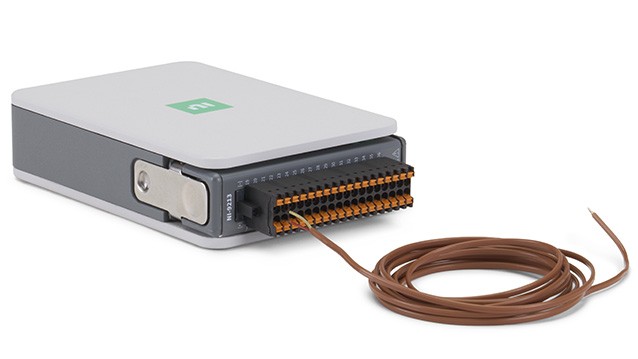
Get an introduction to thermocouples, which are inexpensive sensing devices widely used with PC-based data acquisition systems. Also review some specific thermocouple examples and learn how thermocouples work and ways to integrate them into a data acquisition measurement system.

View comprehensive tutorial >>

See the how-to guide >>

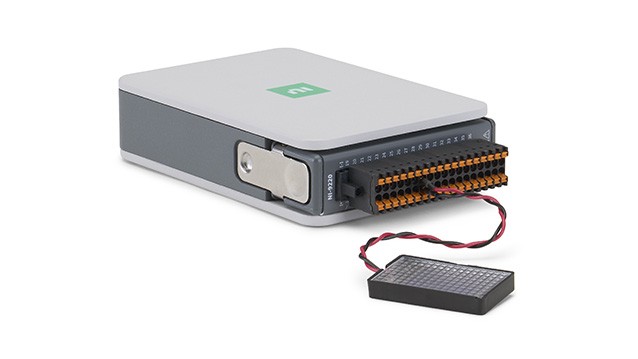
Measuring Temperature with an RTD or Thermistor


  Explore resistive temperature detectors (RTDs) and thermistors, which are both electrical resistors with resistance that changes with temperature. In this tutorial, learn more about RTDs and thermistors as well as how to integrate them into a data acquisition measurement system.

View comprehensive tutorial >>

See the how-to guide >>

Measuring Strain with Strain Gages


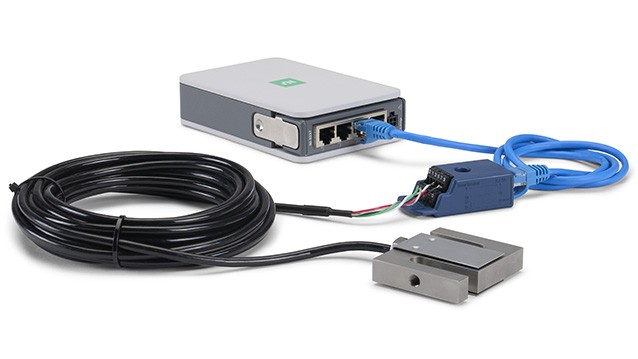
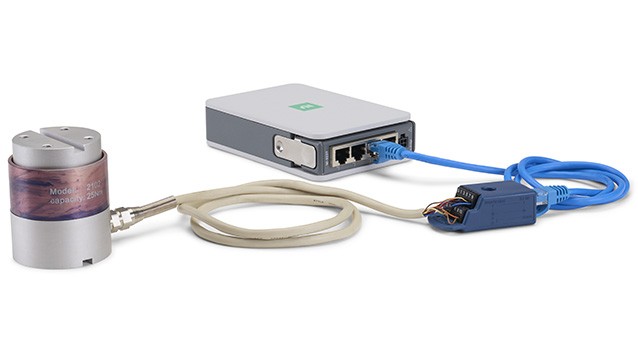
Become familiar with the basics of strain gages, which are commonly used to measure the deformation of a body due to an applied force. Learn more about strain itself, how strain gages work, and how to accurately measure strain with a strain gage.

View audiovisual presentation >>

View comprehensive tutorial >>

See the how-to guide >>

Measuring Pressure with Pressure Sensors


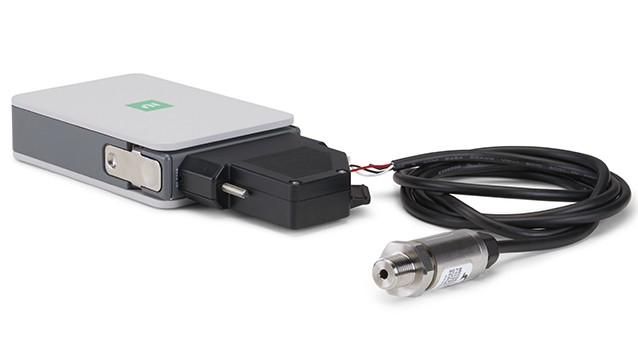
Review pressure measurement basics. Pressure is defined as the force per unit area that a fluid exerts on its surroundings, and pressure sensors measure this force. Learn more about pressure itself, the different types of pressure sensors, how pressure sensors work, and how to integrate a pressure into a measurement system.

View comprehensive tutorial >>

See the how-to guide >>

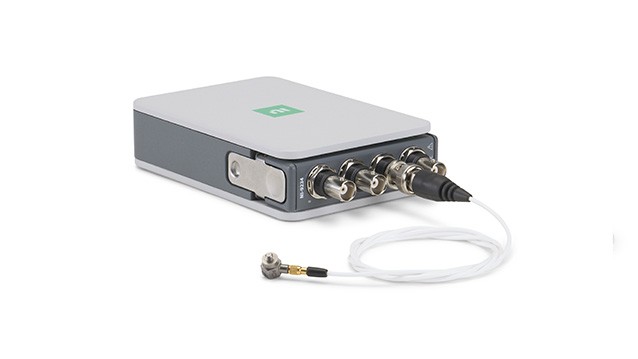
Accelerometer Principles


   Explore the several physical processes that you can use to develop a sensor to measure acceleration. In applications that involve flight, such as aircraft and satellites, accelerometers are based on rotating mass properties. In the industrial world, however, the most common design is based on a combination of Newton's law of mass acceleration and Hooke's law of spring action.

View comprehensive tutorial >>

See the how-to guide for sound and vibration measurements >>


43 ratings | 3.98 out of 5
Read in | Print

Reader Comments | Submit a comment »


Legal
This tutorial (this "tutorial") was developed by National Instruments ("NI"). Although technical support of this tutorial may be made available by National Instruments, the content in this tutorial may not be completely tested and verified, and NI does not guarantee its quality in any way or that NI will continue to support this content with each new revision of related products and drivers. THIS TUTORIAL IS PROVIDED "AS IS" WITHOUT WARRANTY OF ANY KIND AND SUBJECT TO CERTAIN RESTRICTIONS AS MORE SPECIFICALLY SET FORTH IN NI.COM'S TERMS OF USE (http://ni.com/legal/termsofuse/unitedstates/us/).