RF and Wireless Communications: Educator and Classroom Resources
Overview
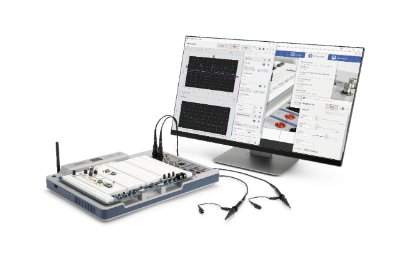
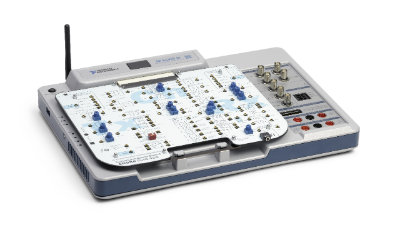
Teaching and research related to communications systems requires a flexible platform that scales from software design to hardware prototyping. The National Instruments platform combines intuitive software with precision measurement hardware to enable hands-on learning and pioneering research.
Testimonials
“As a result of the flexibility of LabVIEW and high-quality NI hardware, we can innovate in teaching and research, making our students prime candidates for becoming next-generation leaders in wireless communications.”
Dr. Robert W. Heath, The University of Texas (Austin)
Resources
| Classroom Resources Download sample courseware, instructor slides and links to university course web sites |
Software Simulations & Examples Explore example labs, LabVIEW demos, and project ideas |
|||
| Textbooks, Applicable Courses & Topics Discover the textbooks that use LabVIEW to teach RF & communications |
Hardware Labs & Exercises |
|||
| Case Studies & Conference Papers See how other schools use LabVIEW for RF & communications |
Videos & Webcasts |
|||
|
|
Software Licensing Options Adopt LabVIEW at your institution with these licensing options | Recommended Lab Configurations Outfit your teaching and research labs with these setups |
||
Visit ni.com/academic for additional teaching and research resources
Classroom Resources
Digital Communications Lab at the University of California (San Diego)
Professor George Papen at the University of California (San Diego) teaches a Digital Communications Lab with NI LabVIEW and NI RF modular instruments. The course web site includes lab assignments, lecture slides, and more.
Read more or visit the web site...
Digital Communications Lab at the University of Illinois
Professor Christopher D. Schmitz at the University of Illinois (Urbana -Champaign) teaches a digital communications lab using LabVIEW. The course web site includes lab exercises, projects, handouts, and more.
Visit the web site...
Software Simulations and Examples
The following LabVIEW examples explore a variety of communications concepts. These examples are software-only simulations that do not require any hardware.
Amplitude Modulation |
|
| This example includes background information and step-by-step instructions that examine Amplitude Modulation (AM). We will construct a LabVIEW VI that transmits and receives a signal in software using AM. Download Now. |
|
Frequency Modulation |
|
| This example includes background information and step-by-step instructions that examine Frequency Modulation (FM). We will construct a LabVIEW VI that transmits and receives a signal in software using FM. Download Now. |
|
Single Sideband Modulation (SSB) |
|
| This example examines Single Sideband Modulation (SSB) with a LabVIEW VI that produces a modulated single-sideband signal. Download Now. |
|
Amplitude Shift Keying (ASK) |
|
|
|
This example includes background information and step-by-step instructions that examine the Amplitude Shift Keying (ASK) digital modulation scheme. We will construct a LabVIEW VI that transmits and receives a bit stream in software using ASK. Download Now. |
Frequency Key Shifting (FSK) |
|
| Frequency Shift Keying (FSK) is a digital modulation scheme that modulates a carrier sinusoid's frequency to transfer digital information. In this step-by-step exercise, we will construct a LabVIEW VI that transmits and receives a digital bit stream in software using FSK. Download Now. |
|
Phase Shift Keying (PSK) |
|
| This example includes background information and step-by-step instructions that examine the Phase Shift Keying (PSK) digital modulation scheme. We will construct a LabVIEW VI that transmits and receives a digital bit stream in software using PSK. Download Now. |
|
Differential Phase Shift Keying (DPSK) |
|
| This example includes background information and step-by-step instructions that examine the Differential Phase Shift Keying (DPSK) digital modulation scheme. We will we will construct a LabVIEW VI that transmits and receives a digital bit stream in software using DPSK. Download Now. |
|
OQPSK |
|
| Offset Quadrature Phase Shift Keying (OQPSK) is a variant of Phase Shift Keying modulation that uses four different values of the phase to transmit. This example LabVIEW VI transmits and receives a digital bit stream in software using OQPSK. Download Now. |
|
Minimum Shift Keying (MSK) |
|
|
|
This example examines the Minimum Shift Keying (MSK) digital modulation scheme. Download Now. |
QAM Symbol Mapping |
|
| This example includes background information and step-by-step instructions that examine the Quadrature Amplitude Modulation (QAM) digital modulation scheme. Download Now. |
|
QAM M-ary vs. Channel Noise |
|
| This step-by-step demo illustrates the effect of channel noise on an M-ary QAM signal with a LabVIEW-based simulation that shows how noise can effect the transmission of a textual message. Download Now. |
|
Phase-Locked Loops |
|
| This demo examines the theory behind phase-locked loops with a LabVIEW-based simulation that synchronizes the phase of a generated signal with a reference signal. Download Now. |
|
LPF and HPF Filter |
|
| This example includes background information and step-by-step instructions that explore high- and low-pass filters. We will construct a LabVIEW VI that blocks or attenuates signals of frequencies outside the specified band. Download Now. |
|
Time Division Multiplexing (TDM) |
|
| This example introduces Time Division Multiplexing (TDM) with a LabVIEW-based simulation that appends one signal to the end of another, and displays each in both analog and digital formats. Download Now. |
|
OFDM |
|
| This example examines orthogonal frequency-division multiplexing (OFDM) with a LabVIEW-based simulation of a multi-carrier OFDM digital communication system. Download Now. |
|
Pulse Width Modulation (PWM) |
|
| This example includes background information and step-by-step instructions that explore Pulse Width Modulation (PWM), a digital modulation scheme that transmits analog information by altering pulse width. Download Now. |
|
Pulse Position Modulation (PPM) |
|
| This example includes theory and step-by-step instructions that explore Pulse Position Modulation (PPM). Download Now. |
|
Pulse Amplitude Modulation (PAM) |
|
| This example includes background information and step-by-step instructions that explore Pulse Amplitude Modulation (PAM). In this exercise, we will construct a LabVIEW VI that transmits analog information by changing pulse amplitude. Download Now. |
|
IQ Data |
|
| This demo introduces IQ data and explores why it is useful in communications. We will analyze three LabVIEW VI's that show how IQ data represents changes in the magnitude and phase of a sine wave. Download Now. |
|
Sampling Theorem |
|
| This step-by-step example examines the sampling theorem and how it is used to determine minimum sampling speeds. In this exercise, we will construct a LabVIEW VI that illustrates the concept behind the sampling theorem. Download Now. |
|
Channel Coding |
|
|
|
This example examines the processing technique of channel coding with a LabVIEW-based simulation that illustrates how channel coding allows original data to recover from noise in the channel. Download Now. |
Carrier Recovery |
|
| Channel noise can have a significant effect on carrier recovery. In this demo, we will analyze a LabVIEW VI that shows what behavior can occur when channel noise is significant enough to prevent carrier locking. Download Now. |
|
Hardware Labs and Exercises
The following hardware-based exercises and labs can be used to explore communications concepts using live signals.
Amplitude Modulation |
|
| This lab examines the Amplitude Modulation (AM) analog modulation scheme. Fundamentally, analog modulation techniques require changing characteristics of a carrier wave over time. Download Now. |
|
Frequency Modulation |
|
| This lab explores the Frequency Modulation (FM) analog modulation scheme. In this exercise, we will examine two LabVIEW VI's that transmit and receive FM signals using hardware. Download Now. |
|
Phase Modulation (PM) |
|
|
|
This lab examines the Phase Modulation (PM) analog modulation scheme. Using hardware along with LabVIEW VI's, we will transmit and receive a signal with PM. Download Now. |
Single Sideband Modulation (SSB) |
|
| This lab examines Single Sideband Modulation (SSB) using hardware. In this exercise, we will analyze two LabVIEW VI's that transmit and receive a modulated single-sideband signal. Download Now. |
|
Amplitude Shift Keying (ASK) |
|
| This step-by-step lab explores the Amplitude Shift Keying (ASK) digital modulation scheme. In this exercise, we will look at LabVIEW VI's that transmit and receive a digital bit stream in hardware using ASK. Download Now. |
|
Frequency Key Shifting (FSK) |
|
| This lab looks at the Frequency Shift Keying (FSK) digital modulation scheme using hardware. We will analyze two LabVIEW VI's that, using FSK, transmit and receive a digital bit stream. Download Now. |
|
Phase Shift Keying (PSK) |
|
| This lab examines the Phase Shift Keying (PSK) digital modulation scheme using hardware. In this exercise, we will examine LabVIEW VI's that transmit and receive a digital bit stream using PSK. Download Now. |
|
Differential Phase Shift Keying (DPSK) |
|
| Differential Phase Shift Keying (DPSK) is a digital modulation scheme that uses bit patterns to change the phase of a wave as opposed to setting it to a new value. In this lab, we will use hardware to explore two LabVIEW VI's that transmit and receive a digital bit stream using DPSK. Download Now. |
|
Offset Quadrature Phase Shift Keying (OQPSK) |
|
| Offset Quadrature Phase Shift Keying (OQPSK) is a variant of Phase Shift Keying modulation using 4 different values of the phase to transmit. In this lab, we will use hardware to examine two LabVIEW VI's that transmit and receive a digital bit stream using OQPSK. Download Now. |
|
Minimum Shift Keying (MSK) |
|
| This lab looks at the Minimum Shift Keying (MSK) digital modulation scheme. In this exercise, we will use hardware to analyze two LabVIEW VI's that transmit and receive a digital bit stream using MSK. Download Now. |
|
Quadrature Amplitude Modulation (QAM) |
|
| This lab examines the Quadrature Amplitude Modulation (QAM) digital modulation scheme. Using hardware, we will examine two LabVIEW VI's that transmit and receive a digital bit stream using QAM. Download Now. |
|
Pulse Amplitude Modulation (PAM) |
|
| This lab illustrates the theory behind Pulse Amplitude Modulation (PAM), and introduce practical aspects of its implementation. We will take a look at two LabVIEW VI's that transmit and receive analog information by changing pulse amplitude. Download Now. |
|
Textbooks and Applicable Courses
Textbooks
![]() |
Production Testing of RF and System-On-A-Chip Devices for Wireless Communication Keith B. Schaub
|
![]() |
Digital Signal Processing and Digital Communications Cory Clark |
Applicable Courses / Topics
|
|
Case Studies and Conference Papers
Case Studies
-
UC Berkeley Develops Communications Lab with NI Tools, In a novel initiative to increase interactive learning, professors at the University of California at Berkeley tightly integrate communication theory classes with real-world wireless communication signals and systems. Read more...
-
University of Illinois Develops Communications Lab, The University of Illinois at Urbana-Champaign developed an undergraduate Digital Communications Laboratory course that connects communication theory, design, prototyping, and system deployment using graphical system design. Read more...
-
UT and Drexel Use NI PXI and LabVIEW for Wireless Research, Professors developed a next-generation multiple input, multiple output (MIMO) network prototype using National Instruments PXI RF modules, RF software, and LabVIEW. Read more...
-
Wireless Ad-Hoc Networks Research at the University of Texas (Austin), Professor Jeffrey Andrews at the University of Texas (Austin) is involved in LabVIEW-based research regarding wireless, Ad Hoc networks. Read more...
Conference papers
-
Innovative Communications Experiments Using an Integrated Design Laboratory, The University of Wyoming takes an innovative approach to teaching digital communications that builds on NI LabVIEW. Read the paper...
-
Explorations in Communications Systems using a Virtual Toolkit, Dordt College Professor Murat Tanyel applies LabVIEW and the Modulation Toolkit to teaching a Communications Systems course. Read part 1..., Read part 2...
-
Wireless OFDM-based Real-Time Video Streaming, Researchers at the American University of Beirut implemented an OFDM based radio using NI hardware to stream wirelessly video from one computer to another. Read the paper...
Videos and Webcasts
-
Video: Simulate Low-Frequency AM Modulation with LabVIEW
Software Licensing Options
|
|
NI Academic Site License
|
|||
Student Install Option
|
||||
Recommended Lab Configurations
NI PXI-5660 - 2.7 GHz RF Vector Signal Analyzer
|
||||
NI Modulation Toolkit
|
||||
Recommended Lab Configurations
Reader Comments | Submit a comment »
Legal
This tutorial (this "tutorial") was developed by National Instruments ("NI"). Although technical support of this tutorial may be made available by National Instruments, the content in this tutorial may not be completely tested and verified, and NI does not guarantee its quality in any way or that NI will continue to support this content with each new revision of related products and drivers. THIS TUTORIAL IS PROVIDED "AS IS" WITHOUT WARRANTY OF ANY KIND AND SUBJECT TO CERTAIN RESTRICTIONS AS MORE SPECIFICALLY SET FORTH IN NI.COM'S TERMS OF USE (http://ni.com/legal/termsofuse/unitedstates/us/).