CompactDAQ Technology: Multiple Timing Engines, Signal Streaming, and More
Overview
Contents
- C Series I/O Modules
- Integrated Processor and Storage
- Mechanical Design
- Multiple Timing Engines for Multiple Acquisition Rates
- Advanced Counter Functionality From NI-STC3 Technology
- NI Signal Streaming Technology
- Software Options With CompactDAQ
- Purchasing Information
C Series I/O Modules
Choose from more than 60 C Series I/O modules for different measurements including thermocouple, voltage, resistance temperature detector, current, resistance, strain, digital (TTL and other), accelerometer, and microphone. Channel counts on the individual modules range from 1 to 32 channels to accommodate a wide range of system requirements. C Series I/O modules combine signal conditioning, connectivity, and data acquisition into a small module for each specific measurement type, which reduces system complexity and increases measurement accuracy. These modules can be inserted into any C Series chassis or controller to create a variety of systems. You can select the modules you want and install them into one of several CompactDAQ systems to create a mix of channel counts and measurement types within one system. With CompactDAQ, you can build the right system to meet the needs of your measurement application.
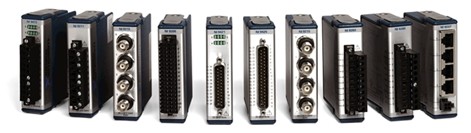
Figure 1. Choose from more than 60 C Series I/O modules.
Integrated Processor and Storage
CompactDAQ controllers further the integration of your DAQ system by combining the processor and data storage with the data acquisition and signal conditioning in a small, rugged form factor. NI has partnered with Intel to deliver industrial processors, such as the quad-core and dual-core Atom processors, to the DAQ market. In addition, CompactRIO with NI-DAQmx controllers offer the same integration combining the processor and data storage with the DAQ and signal conditioning to your DAQ system while adding the benefit of a user-programmable FPGA to perform custom timing and triggering and control algorithms directly in hardware to maximize reliability and determinism.
Mechanical Design
Instrumentation placement and installation are important parts of a test setup. You can minimize surrounding electrical noise by placing instrumentation close to the test subject because the digital signals used by USB, Ethernet, 802.11 WiFi, and several other protocols are less susceptible to electromagnetic interference. CompactDAQ can measure many channels in a small, rugged package so that you can place it close to the unit under test. CompactDAQ systems offer the following mechanical design features.
Rugged, Versatile Chassis With Flexible Mounting Options
- Ability to hold 1, 4, 8, or 14 C Series I/O modules
- Ability to transfer data over USB, Ethernet, or 802.11 WiFi or choose a stand-alone option with an embedded computer
- A380 metal construction for durability
- 30 g shock and 0.3 grms operational vibration in accordance with IEC-60068-2-27/64 for most chassis
- 50 g shock and 5 g operational vibration in accordance with IEC-60068-2-27/64 for the cDAQ-9185/9189 chassis
- -20 °C to 55 °C operational temperature for most chassis and controllers
- -40 °C to 70 °C operational temperature for the cDAQ-9185/9189 chassis
- Panel, rack, DIN-rail, and desktop mounting kits
- 2D and 3D drawings (refer to the Dimensional Drawings Database on ni.com)
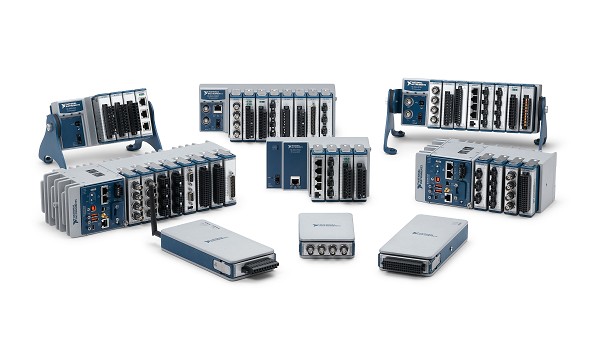
Figure 2. CompactDAQ chassis and controllers offer 1-, 4-, 8-, or 14-slot options.
Cable and Signal Wire Strain Relief for Solid Connections
- Power connection is attached to chassis with screws and includes a protective back shell for safety
- USB cable locks to USB chassis with thumbscrew (locking USB cable included in USB chassis kits)
- Ethernet cable locks with latch mechanism (standard Ethernet cable sold separately)
- All modules either are shipped with strain relief covers or have them available as accessories to prevent wire removal
- Shock and vibration tests are conducted with power, communication, and module signal wires connected
Built-In Trigger Lines for Import/Export of Digital Clocks
- 8 and 14-slot USB chassis have two BNC connections for trigger lines
- cDAQ-9185/9189 chassis include an SMB connector for a trigger
- Bandwidth to support up to a 1 MHz clock
- Ability to synchronize multiple systems (system synchronization not compatible with all modules, see chassis manual)
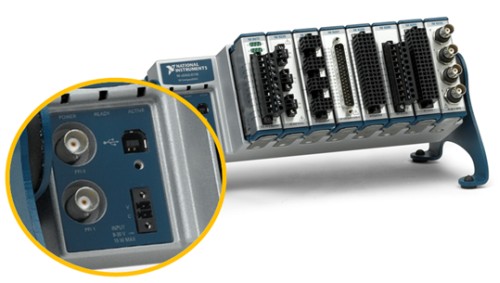
Figure 3. The close-up shows the power input, BNC trigger lines, and locking USB port on the cDAQ-9178.
Automatic Synchronization of Modules and Channels
- Additional modules can be plugged in to add more measurement types and channels to the system
- Modules are hot-swappable and autodetect once you insert them into a CompactDAQ chassis or controller
- A single CompactDAQ system can simultaneously stream high-speed analog input, analog output, digital input, and digital output
- Multiple TSN-enabled CompactDAQ chassis can be synchronized over the network with standard Ethernet cables
- Multiple CompactDAQ USB chassis can be synchronized with the NI 9469 module and RJ50 cable
Visit the CompactDAQ chassis model page for prices and ordering information
Multiple Timing Engines for Multiple Acquisition Rates
A vital piece of a DAQ system is the A/D converter, which needs clock signals to designate when to acquire samples. Many systems have multiple A/D converters that share the same clock to synchronize all of the channels’ measurements. CompactDAQ systems have the advantage of flexibility when it comes to timing engines and go beyond standard synchronization.
CompactDAQ chassis have three analog input timing engines. This makes it possible for programmers to divide all of their analog inputs in up to three different groups known as tasks:
- Each task can run at a separate rate, as seen in Figure 4. This is ideal when combining temperature measurements, which are often slow, with higher speed measurements such as sound and vibration.
- The three tasks operate independently, can be addressed from separate loops or threads in a program, and can be started simultaneously.
- All channels within a single task are automatically synchronized. In the event a multiplexed module is combined in a task with a simultaneous sampling module, the first channel in the multiplexed module is synchronized and the subsequent channels in the multiplexed module scan through in succession.
- All channels within a single task, simultaneous and multiplexed, are returned at the requested sample rate.
- All modules can be placed in a single task. This synchronizes all channels to the same clock.
CompactDAQ can perform up to seven tasks simultaneously. You can choose from several task options:
- Analog input with up to three timing engines
- Digital input with designated timing engine
- Digital output with designated timing engine
- Analog output with designated timing engine
- Counter/timer tasks for quadrature, PWM, event, period, or frequency measurement (CompactDAQ chassis contain four built-in counter/timers that you can access through a digital module)
By having a designated resource, digital and analog output tasks can run independently without having to share a clock signal from another task. This makes the programming easier and more intuitive. Designated resources can be shared with other subsystems of the chassis. For example, you can share the digital input clock with the analog output clock to generate a voltage with every rising/falling edge of the digital input.
The multiple timing engines and ability to route and share resources provide a level of flexibility to CompactDAQ unequaled by most off-the-shelf DAQ systems.
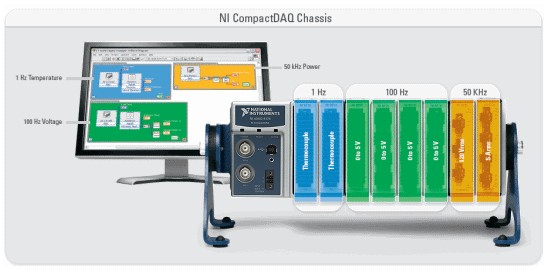
Figure 4. Different analog input tasks can run at different rates in the same chassis.
For even more flexibility when it comes to timing engines, CompactRIO with NI-DAQmx controllers offer users the ability to use a separate timing engine per slot on the controller. This allows the user to have up to 8 timing engines per controller providing the flexibility to use all 8 of those timing engines to program 8 analog input tasks using NI-DAQmx all running at an independent sampling rate simultaneously which are hardware-timed.
Click here to learn more about concurrent tasks on CompactDAQ
Advanced Counter Functionality From NI-STC3 Technology
Some of the core technology in CompactDAQ chassis and controllers is shared with other NI DAQ products. This technology is known as the third generation of the system timing controller (NI-STC3). Many devices use off-the-shelf clocks and oscillators for system timing. NI technology is designed for performance from the ground up, starting with the timing engines and 30 years of PC-based instrumentation experience. NI-STC3 technology is proprietary source code that is built into an ASIC and separates systems like CompactDAQ from all other devices on the market.
Four Advanced 32-Bit Counter/Timers
- You can use counters for event counting, quadrature encoder measurement, PWM, pulse train generation, or period or frequency measurement.
- NI-STC3 counters are advanced because they contain an embedded or onboard auxiliary counter. This is not directly accessible by the user, but it is accessed by the driver for some frequency measurements. These processes normally require two cascaded counters, but with NI-STC3 technology, these advanced counters can do more with fewer resources.
- You can share resources to synchronize counter tasks to other counter, digital, or analog tasks.
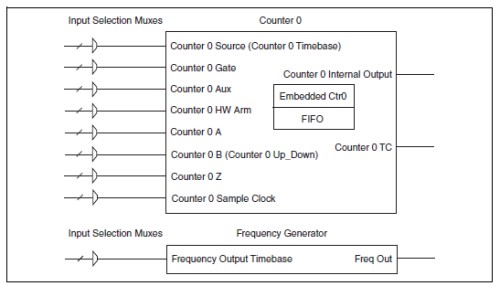
Figure 5. The diagram shows the Counter 0 and Frequency Generator.
Built-In Frequency Generator
- 10 MHz, 20 MHz, and 100 kHz base clocks
- 16 divisors (n=1..16)
- Output through an installed hardware-timed digital module or built-in BNC trigger lines (1 MHz bandwidth limit on built-in trigger lines)
Advanced Counter and Digital Features
- Change detection event
- Hardware triggering (start, reference, and pause)
- Programmable function interface (PFI) terminals used for input/output timing signals for analog, digital, or counter functions
- 8 counter input functions
- 5 counter output functions
NI Signal Streaming Technology
Communication buses, such as USB, Ethernet, and 802.11 WiFi, have a standardized data structure and a defined method of how a device communicates with the host, but not all devices are created equal. Patented Signal Streaming technology sets out to operate NI DAQ devices most efficiently within the bounds of these bus standards. Many consumer products need only one or two streams of directional data. Music players and storage devices often move large quantities of data in one direction, updating to or from the host PC. Test systems often involve multiple inputs and outputs running simultaneously. Signal Streaming enables high-speed, bidirectional data streaming to and from the CompactDAQ system.
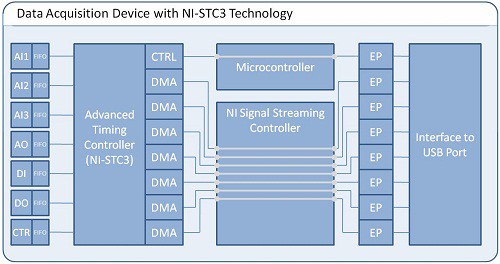
Figure 6. Signal Streaming enables parallel streaming of data from multiple tasks with minimal processor involvement.
Software Options With CompactDAQ
With CompactDAQ systems, you can develop measurement and test applications in multiple programming environments, including ANSI C/C++, Visual C#, and Visual Basic .NET. However, tight hardware and software integration makes the LabVIEW development environment the best choice for getting the most performance out of your CompactDAQ system with the least programming effort.
LabVIEW is a programming environment for developing sophisticated measurement, test, and control systems using intuitive graphical icons and wires that resemble a flowchart. LabVIEW offers unrivaled integration with thousands of hardware devices, including the CompactDAQ platform, and provides hundreds of built-in libraries for advanced analysis and data visualization. You can automate measurements from several devices, analyze data in real time, and create custom reports in just minutes using this industry-standard tool.
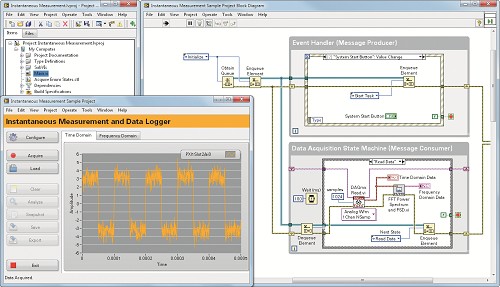
Figure 7. Graphical programming and dataflow representation make you more productive by giving you that ability to program just like you think.